
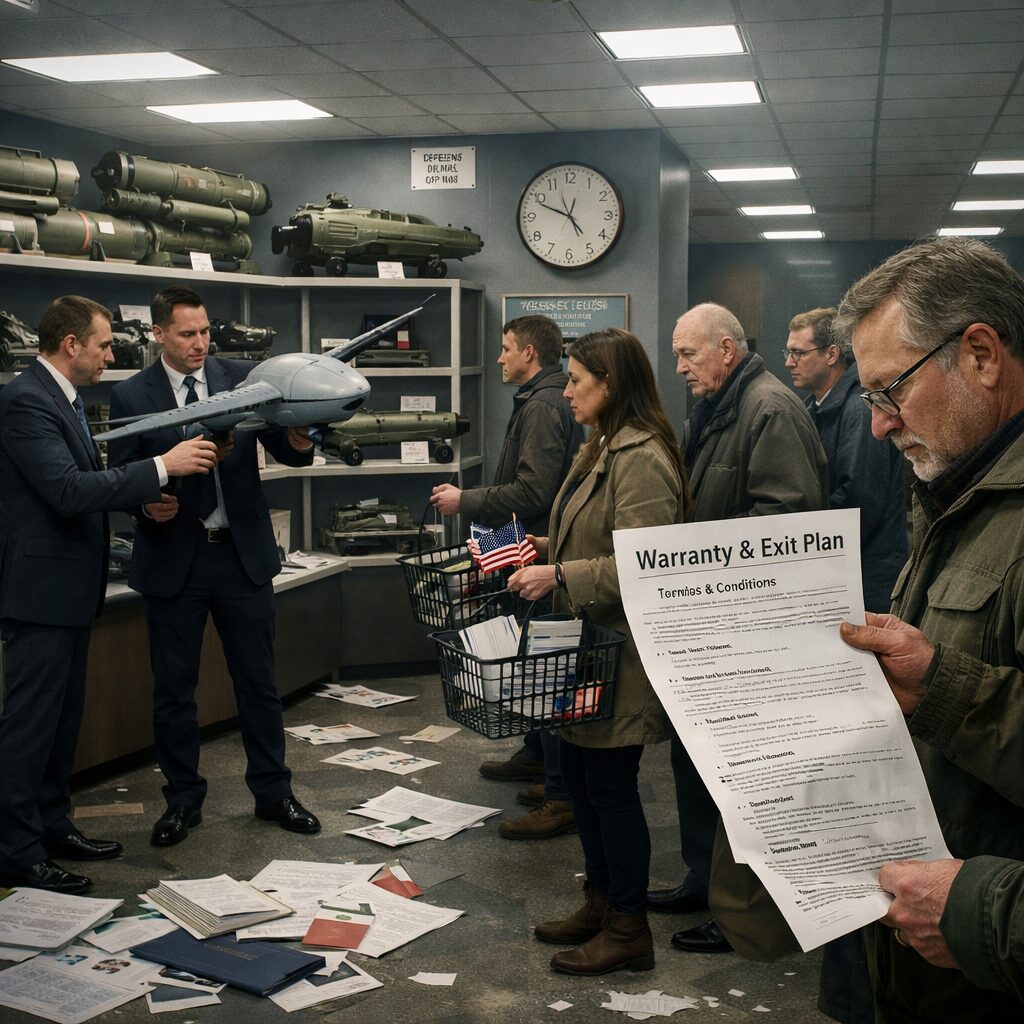
Front of Shop: Mistaking Marketing for Strategy
The first error shoppers make is being dazzled by glossy brochures and charismatic salespeople — the war equivalent of flashy weapon demos and cinematic PR. Governments and publics often pick conflicts framed as quick, righteous, easy purchases without reading the fine print. They buy the narrative of decisive victory while ignoring constraints: political, legal, economic and moral.
Avoidance: Demand transparent assessments, not just promotional material. Insist on independent cost–benefit analyses, clear objectives and contingency plans. Treat any proposal like a regulated purchase: ask for lifetime costs, rules of engagement, and audited risk assessments before signing off.
No Return Policy: Forgetting the Exit Strategy
A surprising number of decision‑makers shop for war as if it were a one‑off gadget — no thought for returns, repairs or recycling. Wars have long tails: reconstruction, veterans’ care, legal cases and regional destabilisation. Ignoring the exit strategy often turns a tactical gain into a strategic catastrophe.
Avoidance: Require an explicit, time‑bound exit plan with benchmarks. Budget for post‑conflict governance and humanitarian needs up front. Build legal frameworks that tie funding and support to measurable progress towards clear, pre‑agreed end‑states.
Buying Only Technology: Overestimating Hardware
Many shoppers believe the latest technology is a cure‑all. Drones, cyber tools and precision munitions are tempting purchases, but technology alone cannot deliver political solutions. Overreliance on hardware neglects training, human intelligence, cultural understanding and moral judgement.
Avoidance: Pair acquisitions with investments in local knowledge, language skills, civil affairs and ethical training. Prioritise interoperability, maintenance pipelines and supply chains. Evaluate tools on how they enable political outcomes, not just on headline capabilities.
Ignoring Hidden Costs: Logistics and the Invisible Ledger
The price tag of war is often confined to front‑end procurement figures while logistics, spare parts, medical evacuation, and bureaucratic overhead accumulate unseen. This invisible ledger drains budgets and public trust long after headlines fade.
Avoidance: Insist on full‑lifecycle accounting. Include logistics, training, medical care, and long‑term environmental remediation in procurement contracts. Use transparent reporting dashboards for civilians and parliaments to track ongoing liabilities.
Moral Hazard: Buying War Without Ethical Oversight
Shoppers sometimes purchase the option to wage war without embedding ethical oversight. Private contractors, opaque export deals and relaxed rules of engagement create moral hazards that damage reputations and invite legal consequences.
Avoidance: Embed ethics clauses, human‑rights monitoring and judicial oversight into every contract. Use independent watchdogs, parliamentary committees and international law as checks. Make approvals conditional on adherence to humanitarian standards and transparent reporting.
Emotional Shopping: Letting Sentiment Drive Decisions
Decisions fuelled by anger, fear or righteous indignation are a common pitfall. Emotional shopping leads to rushed commitments, overreach and escalation. Public sentiment can be manipulated by imagery and soundbites designed to sell the notion of war.
Avoidance: Institutionalise deliberation: cooling‑off periods, cross‑party reviews and expert panels. Maintain civic education on media literacy and the fog of propaganda. Ensure that declarations of conflict require not just public support but robust, deliberative consent mechanisms.
Choosing Suppliers Without Due Diligence
A procurement mistake is selecting arms, mercenaries or advisers on convenience, familiarity or price alone. Poor vetting yields equipment that fails in theatre, contractors that flout rules, and partners that entangle you in scandals.
Avoidance: Enforce rigorous supplier vetting, performance bonds and accountability clauses. Use multi‑domain evaluations — technical capability, legal compliance, human‑rights records and financial transparency — before awarding contracts. Include clauses for audits and rapid decoupling if standards slip.
Shopping Locally: Failing to Consider the Regional Market
Buying war without context is like buying a suit without measuring the customer. Conflicts ripple beyond borders; neighbouring states, diasporas and global markets react. Ignoring the regional market produces unintended alliances, arms races and refugee crises.
Avoidance: Conduct regional impact studies and diplomatic consultations before committing. Coordinate with international partners and institutions to mitigate spillover effects. Design strategies that integrate stabilisation, economic aid and diplomatic channels alongside military options.
The Aftercare Package: Neglecting Reconstruction and Memory
Few shoppers budget for aftercare: memorialisation, legal redress, truth commissions and mental‑health services. Neglecting the social and psychological aftermath stokes cycles of grievance and future conflict.
Avoidance: Invest in truth and reconciliation mechanisms, reparations where appropriate, and long‑term psychosocial support. Plan for cultural heritage protection and inclusive narratives that prevent victors’ mythology from seeding the next war.