
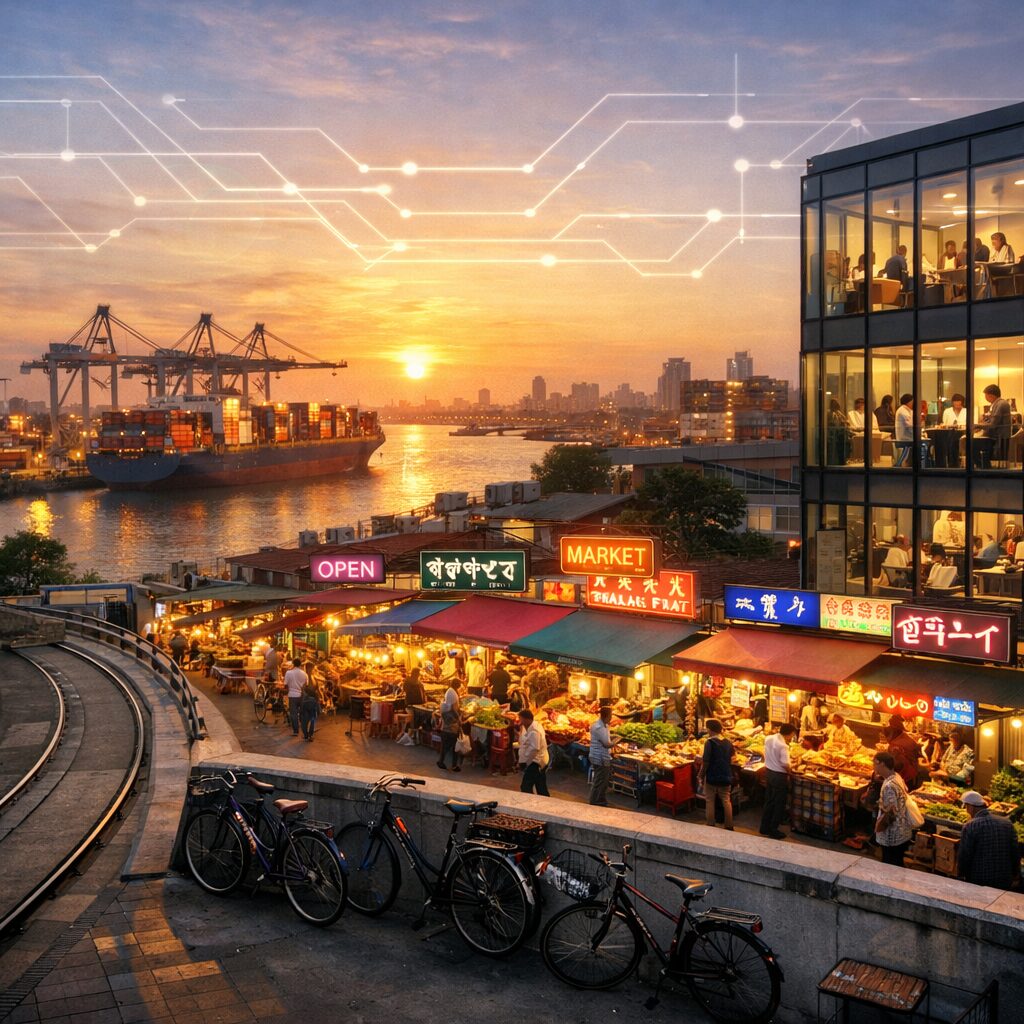
The Invisible Infrastructure of Everyday Life
People think of ‘international’ as flags, embassies or flights. Yet the international is stitched into the seams of daily life in ways most of us never notice. The microprocessor in a smartphone might be designed in California, fabricated in Taiwan, assembled in Vietnam and sold in Nairobi; the coffee in your morning cup was cultivated in Colombia, traded in London and roasted in a small artisan shop two streets away. These supply webs are not abstract; they are operational infrastructures that determine prices, availability and resilience.
When a single port closes, a factory idles, a container ship reroutes or a semiconductor plant experiences downtime, the effect ripples into town centres, hospitals and classrooms. Recognising the international as infrastructure reframes current debates about resilience and sovereignty: it is not merely geopolitical theatre but the plumbing of everything we rely on. Policy that ignores this risk treats society like an island when we are more an archipelago connected by fragile bridges.
Cultural Infrastructure: Soft Power in Everyday Habits
International influence is often reduced to hard power—armies, sanctions, treaties—but soft power is quieter and more pervasive. Cultural infrastructure comprises norms, habits and calendars that travel faster than diplomats. Consider workweek rhythms, weekend leisure industries, school curricula influenced by international testing standards, or global streaming platforms shaping what children imagine as normal.
This cultural exchange creates subtle alignments: cities adopt cycling cultures from Scandinavia, cuisines fuse into new urban identities, and mourning rituals evolve as diasporas reinterpret traditions. Such shifts alter political behaviour, consumer expectations and even mental health outcomes. In short, international cultural flows sculpt the invisible defaults of daily life, making them a potent form of power that governments and corporations both underestimate and deploy.
Data Without Borders: The New Currency of Influence
Data no longer respects national boundaries. From health statistics pooled for pandemic response to user activity analysed by multinational platforms, data flows are the nervous system of the modern world. These flows enable rapid innovation—predictive medicine, targeted disaster relief—but they also concentrate power and create dependencies.
Critically, countries shape rules about data localisation, privacy and algorithmic transparency as a way of exerting influence. The result is a battleground where legal frameworks and technical architectures determine whose values guide automated decisions. Understanding ‘international’ now requires seeing who writes the code, who trains the models and whose datasets become global norms.
Local Politics, Global Ripples
Local elections and municipal decisions increasingly have international consequences. A city’s climate plan influences investment flows; a mayor’s stance on migration shapes regional labour markets; a local court ruling about digital rights becomes precedent for other jurisdictions. The locus of influence is shifting from nation states to networks of cities, corporations and NGOs.
This decentralisation means citizens can wield international power more directly—through city councils, shareholder activism and transnational advocacy networks—but it also complicates accountability. When a multinational project is greenlit by multiple local authorities, tracing responsibility for environmental or social harm becomes labyrinthine. A tactical appreciation of international dynamics is therefore essential for civic engagement and policy-making at the local level.
The Ethics of Interdependence
Accepting that the international permeates everyday life forces an ethical reckoning. Interdependence brings mutual benefit but also shared vulnerability. Should wealthy nations change consumption patterns to reduce strain on fragile supply chains? How do we balance digital openness with protections against surveillance exported via technologies?
Ethical frameworks must evolve beyond charity and state-to-state diplomacy to include supply-chain justice, algorithmic fairness and transnational labour rights. Practical measures—binding standards for living wages in global manufacturing, transnational carbon pricing, and interoperable privacy protections—are not merely idealistic. They are pragmatic necessities if we are to manage the international systems we rely on without perpetuating exploitation or instability.
Practical Steps for Individuals and Institutions
Recognising the international’s quiet power opens up actionable choices. Individuals can cultivate ‘international literacy’: learn where everyday products originate, read beyond national media, and support policies that prioritise resilient, fair supply chains. Institutions should map dependencies, diversify sourcing, and invest in interoperable standards rather than protectionist barriers that mask vulnerabilities.
Investors and planners must assess geopolitical risk as part of routine due diligence; educators should teach students systems thinking that integrates global networks; and civic leaders need forums to coordinate cross-border responses to problems that local ballots alone cannot solve. Small shifts in behaviour and policy, informed by an appreciation of the international’s reach, can yield outsized benefits in stability and justice.