
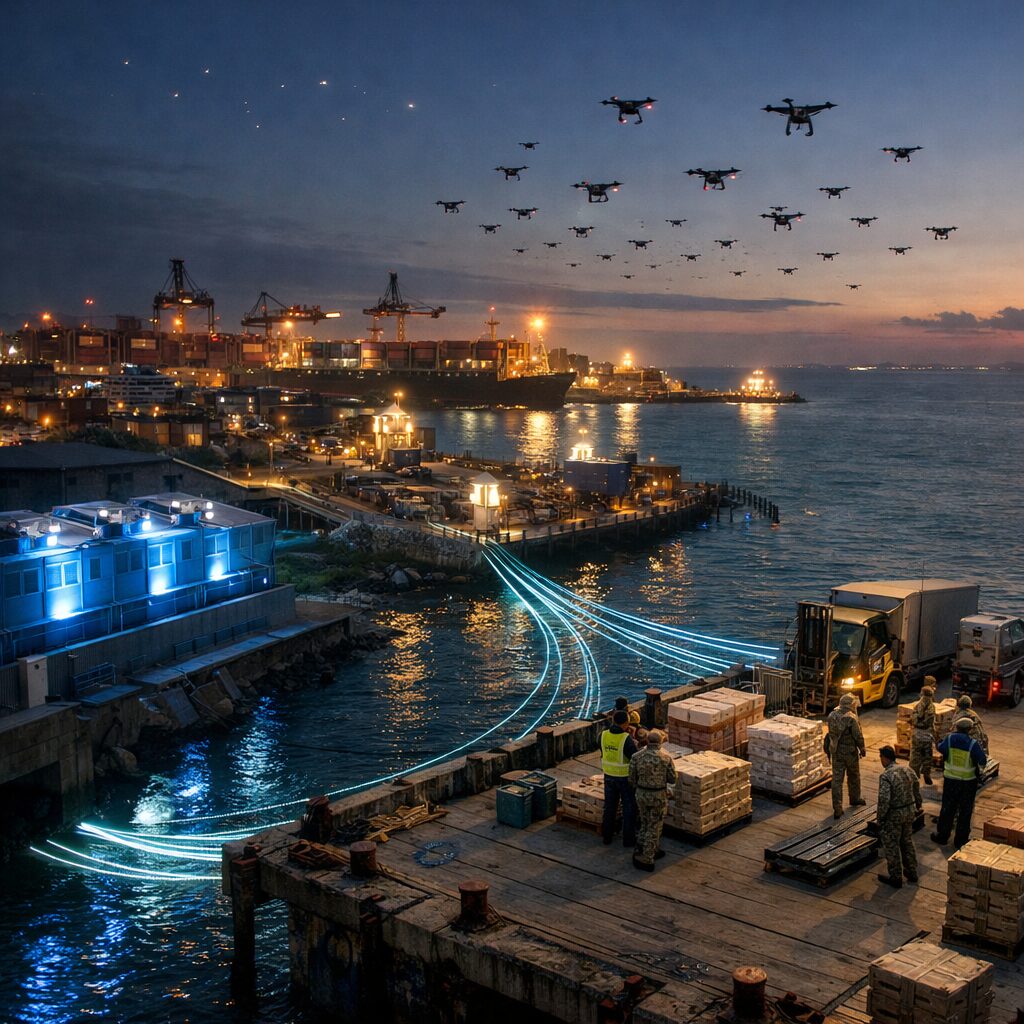
The Invisible Infrastructure of War
War is not just explosions and denunciations; it is an engine that builds and breaks the physical and institutional scaffolding of civilisation. Behind every frontline are logistics hubs, satellite constellations, ports, semiconductor fabs, and legal frameworks that get repurposed for conflict. Those systems quietly become part of daily life long after the guns fall silent.
Consider undersea cables, air traffic control software, and global payment rails: they were never designed with war in mind, yet they become strategic assets the moment states or corporations need to move information, people and capital under duress. Infrastructure resilience strategies, often framed as climate or cybersecurity planning, are increasingly indistinguishable from wartime contingency plans. That convergence means decisions about where to site a data centre or which satellite to trust are now geopolitical, not merely commercial.
War as a Technology Accelerator (and Filter)
Conflict has historically accelerated technologies — from radar and penicillin to the internet and GPS. Today that acceleration operates at digital speed. War compresses timelines: it forces adoption, concentrates funding, and legitimises risky experimentation that peacetime politics would reject.
Equally important is the filtering effect. Resources funnel into a narrower set of solutions, creating winner-takes-most ecosystems. Tactical demands can shove nascent tech like autonomous logistics, hardened AI models, quantum-safe cryptography and encrypted comms into maturity, but they also bias development toward military requirements. That means civilian tech landscapes inherit capabilities shaped first and foremost for conflict, with consequences for privacy, governance and market concentration.
Legal and Normative Laboratories
Wars are laboratories for law and ethics. New practices — targeted sanctions, remote strikes, information operations — force judges, diplomats and tech platforms to invent rules retroactively. The Hague and the UN deliberate classics, but many of the most consequential norms now emerge from crisis-driven court cases, commercial policy updates, and bilateral agreements outside public view.
This norm-creation matters because it sets precedents that outlive the conflict. Rules about cyber coercion, dual-use exports, or emergency data sharing will shape peacetime governance. When states test playbooks during war, they normalise behaviours that may later be used in subtler geopolitical competition, corporate disputes, or domestic politics.
Economic Signals, Supply Chains and Market Transformation
War injects a distorted price signal into world markets. Essential commodities spike, risk premia inflate, and capital re-routes. These shocks reverberate through supply chains, accelerating localisation in some sectors while entrenching dependencies in others.
The modern twist is that wars now target microchips, batteries and cloud capacity — not just oil and grain. That means the next conflict can reconfigure industrial geography: incentive structures will push manufacturing back onshore or into trusted coalitions, compel redundancy in software stacks, and create new financial instruments priced for geopolitical resilience. Ordinary investors and policymakers who ignore these signals risk misallocating capital for decades.
Culture, Memory and the Attention Economy
Beyond material change, war remakes narratives. It turns events into symbols, heroes into brands, and trauma into media franchises. The attention economy exploits and amplifies conflict narratives, refracting them through algorithms that reward simplicity and rage.
These cultural aftershocks influence identity politics, recruitment to causes, and how societies remember — or forget — atrocities. The stories that stick inform curricula, museum curation, and generational attitudes toward risk and governance. In a world dominated by short attention spans, the signal of a war can be turned into a persistent cultural code that shapes behaviour long after battlefields cool.
Why This Matters to You
If war were merely a distant headline, its significance would be contained. But it permeates the bricks-and-mortar of modern life: the apps you trust, the food in your supermarket, the laws that protect or constrain you, even the cultural metaphors you use. Businesses, technologists and citizens who treat conflict as an isolated moral tragedy miss its systemic impact.
Understanding war as an organising principle of 21st-century change empowers better decisions. Policy can be crafted to channel military-driven innovation toward public good. Companies can diversify supply chains and invest in durable governance. Individuals can recognise how narratives are shaped and act accordingly. War matters not because we celebrate it, but because it quietly recalibrates the world we all inhabit.