
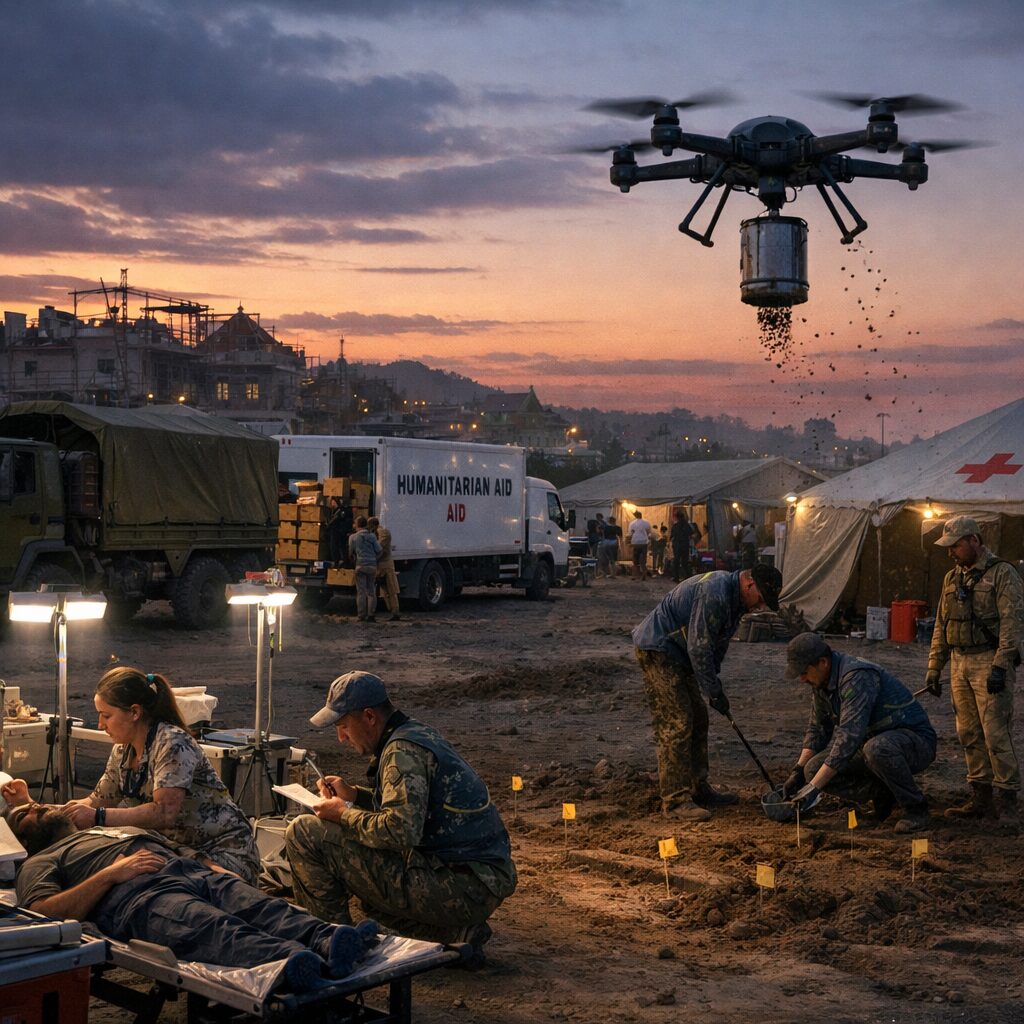
When Tools of War Become Tools for Survival
War has long been a crucible for invention, but a subtler story is unfolding: deliberate, ethical repurposing of military methods to solve civilian crises. From surgical protocols refined on battlefields to drone swarms modelled on combat tactics, actors across governments, NGOs and start-ups are taking instruments of conflict and refashioning them for humanitarian ends. This article traces that uneasy, pragmatic transformation — not as a paean to war, but as an inquiry into how techniques designed for destruction are increasingly applied to preservation, relief and reconstruction.
The paradox is stark. Systems engineered to maximise efficiency in harm can, under tight governance and civilian oversight, become exceptionally potent for rapid aid, environmental restoration and public safety. Understanding how this transfer happens — and its risks — reveals new pathways for solving stubborn real-world problems.
Battlefield Medicine: From Triaging Death to Saving Lives
Modern trauma care owes much to battlefield exigency. Concepts such as rapid haemorrhage control, tourniquet standardisation and damage-control surgery migrated from conflict zones into civilian emergency medicine, dramatically improving survival rates from major accidents and natural disasters. The military’s Trauma System in the United States and NATO’s combat casualty care protocols catalysed civilian trauma networks and training curricula worldwide.
More recently, telemedicine platforms developed for forward-operating bases have been adapted for remote clinics and disaster response. Organisations like Médecins Sans Frontières and the World Health Organization now deploy medic-in-the-loop systems modelled on military casualty evacuation chains, enabling specialist guidance en route to hospital. These adaptations shorten decision cycles, reduce preventable deaths and decentralise expertise to places conventional systems struggle to reach.
Logistics, Command and Control: Military Precision for Humanitarian Scale
Few sectors match the armed forces’ ability to mobilise complex logistics under pressure. That institutional know-how — supply chain modelling, rapid air–sea lift, and unified command structures — has been increasingly borrowed by civilian agencies facing mega-crises. A salient example is the 2010 Haiti earthquake response: military planners helped create coordination hubs, manage port clearance and organise large-scale shelter distribution, accelerating lifesaving deliveries.
This trend has matured into formalised civil–military collaboration doctrines. The United Nations has integrated military logistics frameworks into humanitarian planning, while national disaster agencies run joint exercises with defence forces to synchronise capabilities. The payoff: reduced waste, fewer bottlenecks and the capacity to operate at humanitarian scale when commercial supply chains fail.
Drones and Swarms: From Strike Coordinates to Reforestation and Hazard Mapping
Unmanned systems developed for reconnaissance and precision strike are now pivotal in non-violent missions. High-resolution surveillance drones map post-disaster damage, inform search-and-rescue, and create real-time situational awareness for responders. Beyond observation, the tactical concepts of swarming and distributed autonomy — refined for contested airspace — are being repurposed for environmental remediation.
Start-ups and conservation NGOs deploy drone swarms to distribute seeds across deforested slopes faster and with less soil compaction than human crews. In Spain and parts of Australia, drone-enabled aerial ignition systems, originally derived from military pyrotechnics expertise, are used in controlled burns to reduce wildfire risk. Meanwhile, AI navigation systems built to find the most efficient ingress and egress paths in combat zones help robots enter unstable buildings to locate survivors. These applications illustrate a migration from kinetic objectives to regenerative and protective ones.
Demining and Disarmament: Clearing the Legacy of Conflict to Rebuild Economies
Perhaps the most literal re-purposing of war tools is the global effort to remove them. Demining organisations employ military-grade detection technology, armoured vehicles and remotely operated platforms to clear explosive remnants. Groups such as the HALO Trust and the Mines Advisory Group (MAG) combine former military expertise with community engagement to transform contaminated land back into farmland, schools and marketplaces.
The conversion extends beyond hardware. Weapons-for-development programmes have turned surplus small arms into railings, agricultural tools and art, often under supervised, transparent schemes that build livelihoods and reduce incentives for recirculation of arms. Where clearance projects succeed, the social and economic dividends — restored mobility, renewed markets, revived education — are profound.
Ethics, Governance and the Risk of Normalising Militarised Solutions
Repurposing military capabilities is not without moral and political cost. There is a persistent danger that normalising military tools in civilian spheres erodes democratic oversight, blurs lines between defence and social policy, and privileges rapid technological fixes over long-term political solutions. Deploying armed-model command structures into humanitarian contexts can marginalise local leadership and flatten nuanced accountability.
Robust governance frameworks are essential. Transparency, civil oversight, strict demarcation of roles, and community consent must accompany transfers of capability. International law and humanitarian norms provide guardrails, but they must evolve to cover autonomous systems, data-driven surveillance, and public–private partnerships that bring military tech into civic use. The debate must balance pragmatic benefits against the risk of militarising public life.
Scaling the Model: How to Intentionally Convert Military Know-how for Public Good
If war-derived methods are to be harnessed constructively, deliberate pathways are needed. Recommendations emerging from successful projects include:
– Institutionalised civil–military liaison units that prioritise civilian leadership and community needs.
– Dual-use research criteria that require humanitarian impact assessments before military technologies enter civilian markets.
– Training exchanges that place civilian responders in military logistical exercises — and vice versa — with ethical oversight.
– Investment in demilitarisation programmes that convert surplus materiel into infrastructure while ensuring non-proliferation.
When set up intentionally, these mechanisms reduce ad hocness and embed safeguards that preserve civil norms while extracting genuine societal value from military innovation.
Conclusion: An Unsettling but Practical Reconciliation
The repurposing of war’s tools is an uneasy reconciliation: using systems born of conflict to avert catastrophe, restore ecosystems and save lives. It is neither a justification of war nor a panacea for the structural problems that give rise to violence. Rather, it is a pragmatic recognition that the skills, systems and technologies honed in extreme conditions can be steered toward public benefit — if accompanied by strong ethics, democratic control and an insistence on civilian primacy.
As the world grapples with faster, more frequent crises — pandemics, climate disasters, urban catastrophes — this pragmatic strand of innovation will likely expand. The central challenge will be ensuring that what is borrowed from war serves peace, resilience and justice, rather than becoming a new vector for coercion.