
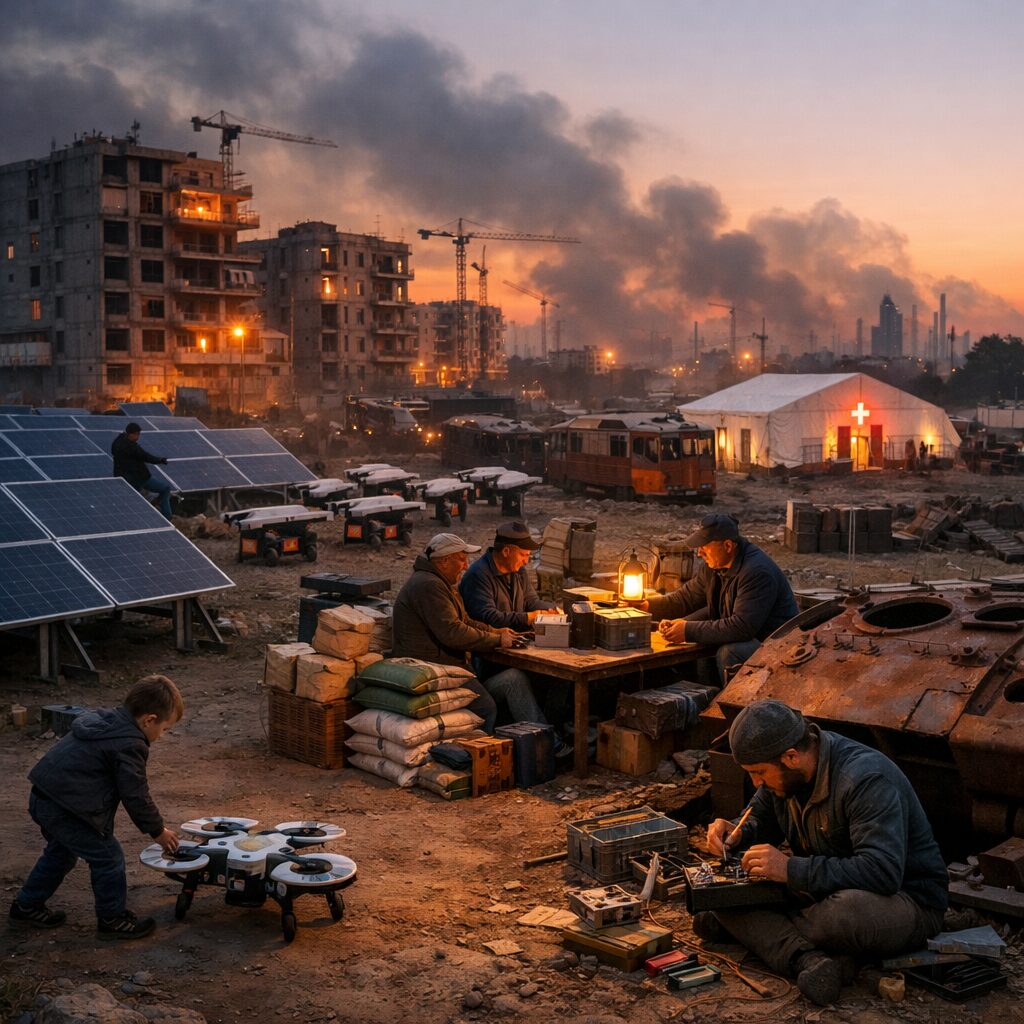
Not Just Violence: War as a Fast-Forward Button on Society
When people say war matters, they usually mean lives lost, geopolitics and border shifts. Those are vital, but they are only the surface. War functions as a societal accelerant — a concentrated pressure that forces rapid technological, organisational and cultural changes that would otherwise take decades. In wartime, markets, governments and civil societies are compressed into a laboratory of urgency. The result is not merely destruction; it is a reordering of priorities, a reallocating of resources and an experimental crucible for innovation.
Consider how conflict zones become testing grounds for technologies from drones and encrypted comms to medical triage and energy resilience. What begins as a battlefield solution migrates into civilian life: improvements in telemedicine, logistics algorithms, materials science and even remote education tools. That transfer is rarely neat or immediate, and often carries ethical and regulatory challenges, but it demonstrates that war is a driver of change that reaches far beyond military doctrine.
Supply Chains, Markets and the Invisible Economics of War
Beyond headlines and sanctions, war rewires the global economy in ways most consumers never see. Modern conflict disrupts critical nodes — ports, microchip foundries, fertilizer plants — and the shockwaves cascade through food security, energy prices and the cost of manufactured goods. These disruptions accelerate trends already underway: reshoring, diversification of suppliers and a frantic hunt for strategic autonomy.
War also serves as a market signal. Investors, states and corporations read conflict as information about supply fragility and geopolitical alignment. That signal drives capital reallocation: more defence procurement, strategic stockpiles, and investments in heavy industry or alternative logistics routes. In effect, war acts like a stress test for globalisation, exposing brittleness and forcing adjustments that persist long after ceasefires are declared.
Institutions Under Strain: Governance, Law and the New Precedents
Conflict pressures legal and institutional frameworks in ways that change the expectations of citizens and states. Emergency powers, censorship, asset freezes and selective rule-bending become precedents that can outlast the immediate crisis. These legal experiments recalibrate the balance between liberty and security, often normalising tools that were once extraordinary.
Moreover, war provokes new norms at the international level. How the world responds to cyberattacks, targeted sanctions, drone strikes and disinformation campaigns today helps define what is permissible tomorrow. Those evolving norms shape everything from human rights practice to corporate compliance, making war a de facto policymaker for the boundary conditions of acceptable state behaviour.
Ecologies and Infrastructure: The Long Tail of Environmental Consequences
The environmental footprint of conflict is profound and under-appreciated. Beyond immediate destruction, war alters land use, contaminates water and soil, and accelerates resource extraction in a scramble to finance rebuilding or sustain military logistics. Ecological damage is not ephemeral; it compounds over decades, reshaping agricultural patterns, biodiversity and even local climate dynamics.
These environmental consequences feed back into human security. Crop failures, displaced populations and degraded ecosystems heighten competition for scarce resources, creating new vectors for instability. Thus, war matters not just for the geopolitical order but for the planetary systems that underpin livelihoods and long-term resilience.
Culture, Memory and the Market for Meaning
War remoulds narratives, identities and cultural consumption. Museums, memorials and media industries curate memories that influence subsequent generations’ conceptions of belonging and grievance. But contemporary conflict also produces a different kind of cultural artefact: viral footage, open-source field reporting, and decentralised archives that bypass traditional gatekeepers.
This shift changes how societies remember and reconcile. It empowers diasporas, shapes international sympathies and drives new cultural industries — literature, film, gaming and art — that monetise and mythologise conflict. In short, war reconfigures the market for meaning, affecting politics, education and global soft power in ways that persist far beyond ceasefire lines.
The Quiet Laboratory of Technology and Ethics
One of the most consequential but least-discussed aspects of war is its role in accelerating ethical dilemmas around emerging technology. Conflicts have become arenas where artificial intelligence, autonomous weapons, biometric surveillance and cyber-operations are not hypothetical but practised. The technologies are stress-tested under real-world constraints — imperfect data, adversarial actors and constrained logistics — producing lessons that shape both capability and ethics.
This is a two-way street: technologies refined in wartime enter civilian life, while civilian norms and legal frameworks later constrain or legitimise their use. The pace and opacity of that cycle means societies often adapt to new capabilities before deliberative governance catches up, making war a de facto incubator for tomorrow’s technological ethics.
Why This Matters to Citizens Who Are Not on the Front Line
If you are not directly affected by fighting, why should you care? Because the secondary consequences are pervasive: higher food and energy bills, new surveillance norms, reconfigured migration flows, and shifts in political discourse that influence public policy and civil liberties. War changes the backdrop of everyday life, from the smartphone apps we use to the taxes we pay and the laws we accept.
Recognising the full scope of war’s influence changes how democracies debate defence, trade and environmental policy. It invites citizens to look beyond immediate humanitarian responses and consider long-term rebuilding, legal safeguards and resilient supply chains. In that way, understanding war as a multiplier of change is not an academic exercise — it is a practical lens for anticipating and shaping the world we will live in after the last gun is silenced.